
Elections Have Consequences: How Australia Voted for Import Dependence

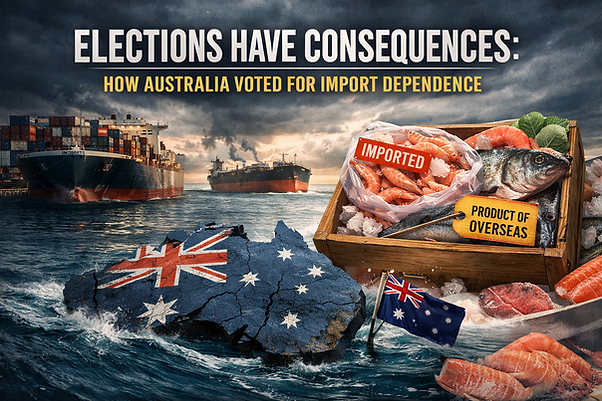
Australia is surrounded by water, rich in resources, and still likes to think of itself as a country that can stand on its own two feet. Yet today we import around 62 to 65 per cent of the seafood we consume by weight, and over 90 per cent of our liquid fuel comes from overseas, either directly as refined fuel or through crude processed offshore. That is not resilience. That is dependence.
This did not happen because Australians suddenly forgot how to fish, farm, refine or produce. It happened because governments, backed by voters election after election, built a legal and policy framework that rewarded cheap imports, centralisation, market efficiency and compliance-heavy domestic production. Each reform was sold on its own merits. More competition. Cheaper prices. Less protection. More global integration. But stacked together over time, those choices have left Australia dangerously exposed.
The problem is not one bad law. It is a chain of decisions.
It started with the belief that efficiency mattered more than sovereignty
Australia spent decades pulling down the protections that once helped local industry survive. Parliamentary material records that barrier protection to manufacturing was reduced from around 35 per cent to 5 per cent by 2000–01. DFAT’s own historical material traces the broader push toward trade liberalisation over the same period, as Australia embraced lower trade barriers and a more globally integrated economy.
That broader philosophy was reinforced through the Competition Policy Reform Act 1995, which formed part of a bigger shift toward competition-driven reform. In theory, it made markets more efficient. In practice, it trained governments to judge policy through the lens of short-term price and competition, not long-term national capability. Spare capacity started to look wasteful. Redundancy started to look inefficient. Sovereign production started to look like a cost, not a safeguard.
Free trade agreements then pushed the same logic further. The Australia-United States Free Trade Agreement entered into force on 1 January 2005, and Australia now has a long list of FTAs in force. Again, each agreement was sold as access, growth and opportunity. But the cumulative effect was to normalise dependence on imported goods, imported inputs and imported processing, while asking fewer and fewer questions about what Australia should still be able to do for itself.
Fuel should have been the warning sign
If Australians want the clearest example of where this model leads, look at fuel. Official government material states that Australia imports over 90 per cent of the refined products and crude oil needed to meet domestic demand. The same material says Australia’s domestic production and reserves have been in decline over the past two decades. That means the trucks moving food, the tractors on farms, the vessels harvesting seafood and the transport network that holds the country together all rely heavily on supply chains outside our control.
Only after the vulnerability became too obvious to ignore did Canberra move to patch the problem. The Petroleum and Other Fuels Reporting Act 2017 put stronger reporting arrangements in place. The Fuel Security Act 2021 then established the legislative framework for a national fuel reserve through a minimum stockholding obligation, and also created a fuel security services payment to support refineries. Those are not signs of foresight. They are admissions that Australia allowed a strategic weakness to develop and then tried to manage it after the damage was already done.
And that is the pattern worth noticing. Governments often do not reverse bad policy until the consequences are already biting. By then, the capacity that was lost is much harder to rebuild.
Seafood tells the same story, only closer to home
Now look at seafood. The Department of Agriculture says 62 per cent of the edible seafood Australians consume by weight is imported. Other recent government-commissioned material puts the figure at around 65 per cent. This is the same country that talks endlessly about sustainability, marine management and food security while importing most of the seafood it eats.
This is not simply a market quirk. It is the result of policy settings that have made domestic production harder to maintain.
At the Commonwealth level, the sector sits under the Fisheries Management Act 1991. In New South Wales, it operates under the Fisheries Management Act 1994, whose objects include conserving fish stocks, habitats and ecological communities while promoting ecologically sustainable development. On top of that sits the Environment Protection and Biodiversity Conservation Act 1999, while in NSW the Marine Estate Management Act 2014 governs marine parks, aquatic reserves and broader marine estate management. Each law has a stated purpose. The issue is what happens when they accumulate on the same domestic producer, year after year, as compliance, access restriction, reporting and uncertainty all pile on together.
That is where the real story sits. The law rarely says, outright, that Australia should import more seafood. Instead, it makes local production harder, slower, dearer and less certain, then acts surprised when imports fill the gap.
The local producer carries the burden, the import still gets the market
This is where the policy failure becomes impossible to ignore. A 2024 report prepared for the Department of Agriculture found that Australia is a net importer of seafood by volume, with around 65 per cent of domestic seafood consumption supported by imports. It also found that while strong measures exist to detect and deter illegal, unreported and unregulated fishing in Australia’s domestic seafood sector, comparatively few measures are currently in place to assess and minimise IUU risk for seafood imports as they enter the Australian market.
So the local operator deals with licences, closures, gear rules, spatial restrictions, reporting burdens, compliance inspections and environmental oversight, while the imported product that increasingly replaces him enters a system the government itself says is comparatively lighter on this specific screening risk. That is not a level playing field. It is a system that is harder on the local producer than the foreign substitute.
The consequences go beyond the wharf. An FRDC-supported report found import penetration remained above 65 per cent and noted that seafood processing sites in Australia had fallen from 439 in 2009 to 261, a decline of 41 per cent. Once processing leaves, a lot leaves with it: jobs, skills, cold-chain infrastructure, value-adding, local buyers and the commercial pathways that help keep domestic harvesters viable.
That is how dependence builds. Not in one dramatic collapse, but in a slow, grinding transfer of capacity out of the country.
Regulation does not just restrict, it exhausts
One of the reasons the political class gets away with this is because the damage is cumulative. A new condition here. A delay there. Another approval hurdle. Another environmental overlay. Another policy that sounds reasonable in isolation but becomes crushing in practice when added to everything else.
Even the government’s own review of the EPBC system found the framework needed significant reform. The Samuel Review concluded that the Act was not delivering for the environment or for business and had become cumbersome, slow and ineffective. That matters because sovereign capacity is not only lost through prohibition. It is also lost through delay, duplication, cost and uncertainty that wear people down until they either scale back, sell out or leave.
That same logic applies well beyond fisheries. It applies to fuel, manufacturing, transport and food production generally. Australia has spent years making it easier to depend on global systems than to maintain domestic capability.
Elections have consequences
That is the real point. Australia’s import dependence is not an accident. It is the cumulative result of choices made by governments and tolerated by voters. Tariff reduction. Competition-first reform. Trade liberalisation. Fuel capacity allowed to decline. Domestic production loaded with rules while imports kept flowing. Labor advanced parts of this framework. The Coalition maintained much of it. In many cases both sides accepted the same basic model. Cheaper now, weaker later.
So when people ask why Australia imports most of the seafood it eats, the answer is bigger than seafood. Seafood is one of the clearest symptoms of a broader political disease. We have built a country that is highly capable at regulating local producers and highly comfortable outsourcing essential capacity. We celebrate efficiency while importing dependence. We talk about resilience while dismantling the foundations that actually make resilience possible.
Elections have consequences.
Australia voted for this, one reform, one agreement, one closure and one Act at a time.


Comments