
Latent Effort in NSW: When Flexibility Is Treated as a Threat

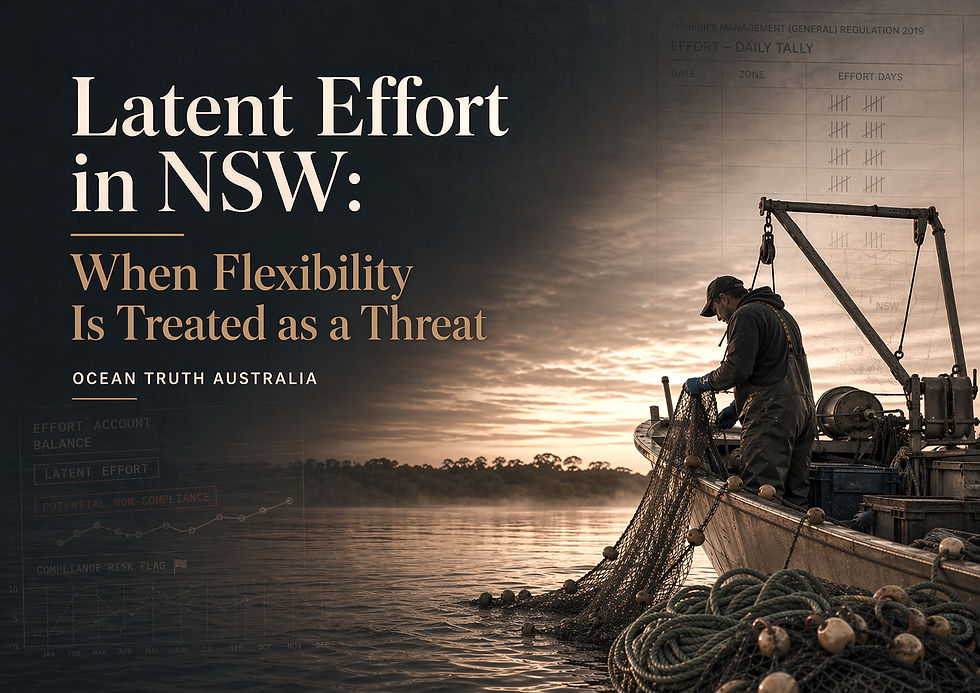
There is a certain language that appears whenever governments, committees and stakeholder bodies want to make one policy direction sound responsible, inevitable and overdue.
The words sound technical. They sound measured. They sound as though the evidence has already done the hard work and the only question left is whether industry will accept the conclusion. In NSW fisheries, two of those terms now carry far more weight than they should: latent effort and social licence.
My argument is simple. In practice, latent effort is being used to turn lawful flexibility into a threat, while social licence is being used to turn organised pressure into something that sounds like public consent. Neither term is as neutral as it first appears. And both are now helping to support a consolidation agenda that reaches well beyond any narrow question of sustainability.
That is why this debate matters. It is not just about stock management. It is about who gets to keep fishing, who is forced to buy or lease more access to stay viable, and whether a working right to fish is now being redefined as a policy problem.
What Is Really Being Argued Here?
The current argument bundles together two very different claims.
The first is a stock protection claim. It says unused capacity inside the fishery could one day be activated and that this creates a sustainability risk that must be addressed.
The second is an asset-value claim. It says the current structure has left effort units and shares with weak market value, and that some form of adjustment is needed to restore order, demand and price.
These are not the same argument. But they are increasingly being spoken as though they are one.
That matters because the official material itself does not support the alarmist version of the story. The public record shows low utilisation of meshing and hauling effort, acknowledges that effort caps have not been the main operative control on fishing mortality, and goes so far as to say there is no current biological imperative to reduce the total allowable effort. At the same time, it openly discusses pathways that would create more demand for shares and effort.
That is the central tension. The debate is presented as conservation, but it also functions as recapitalisation.
Latent Effort or the Right to Fish?
For many operators in the Estuary General Fishery, the term latent effort does not describe reality very well at all.
A mixed-method fishing business does not use every lawful method with the same intensity every season. One method may be the core operation. Another may sit in reserve and only be used when conditions change, when weather closes off one pathway, when prices shift, when access is disrupted, or when something goes wrong with the primary business. That is not a loophole. That is how real businesses manage risk.
My main business is trawl fishing. But when we cannot trawl for whatever reason, meshing and hauling matter. Some years we use more days. Other years we use fewer. We do not sit there thinking in spreadsheet language. We think in terms of our right to fish by that method if we need to.
A few years ago, when the engine in our trawler blew up, meshing and hauling allowed us to keep operating for weeks during what would normally have been our peak trawl season. That was not a hidden threat to sustainability. That was a working fishing business using lawful access to stay afloat and continue supplying local seafood.
A right that is not used every day is still a right.
That is what the latent effort language misses. What is being described as dormant overcapacity is often just retained operational resilience. It is business insurance. It is the ability to adapt to disruption. It is part of how a small or mixed-method operator keeps producing food when one part of the business is down.
Strip that flexibility away and you do not automatically create sustainability. Quite often, you create fragility.
What they call latent effort, fishers often call the right to fish.
How the Problem Was Built Into the System
The present debate is missing its own origin story.
The latent effort problem did not simply emerge from nature. It was shaped by policy design. The historical allocation process flattened real differences between businesses and converted access into tradable paper rights in a way that gave only limited regard to actual catch history. Later, effort days were allocated in proportion to shares held.
That means effort was not simply capped. It was redistributed.
And it was redistributed through a structure that had already diluted the differences between highly active operators and those with much lighter historical use. So when latent effort is now spoken about as though it were a naturally occurring policy emergency, something important is being left out. A significant part of the problem was manufactured when real fishing history was translated into tradable rights through a distorted allocation structure.
Latent effort was not just discovered. Much of it was manufactured.
That is why today’s proposals are not entering a neutral space. They are trying to manage the consequences of an earlier design choice that turned working access into an asset framework and then embedded the tension inside the effort system itself.

Latent Effort and the Fishers’ Answer: We Just Want to Fish
None of this is a new complaint, and it was never confined to a handful of voices.
When regional industry meetings were held across NSW in 2015, fishers turned up in substantial numbers. In Tuncurry alone, 46 attended. Wallis Lakes drew 27. The Hawkesbury meeting at Brooklyn drew 52. Newcastle drew 36. The broader message from that meeting cycle was that the Coalition had already met with more than 300 fishers from border to border.
That matters because it shows this was not an isolated grievance. It was a broad industry response.
The statewide summary captured the same structural objection that is being raised again now. Fishers argued that no one should have to invest further just to secure their existing access rights. They wanted security of access. They wanted multi-endorsement flexibility. They warned that increased leasing would simply raise costs against return. They also argued that over-allocation caused by past policy should not be treated as an industry problem to resolve.
In other words, fishers were already saying a decade ago that they did not want a paper-rights game. They wanted secure access and the freedom to keep working.
At Newcastle the message was put plainly: we just want to go to work. In the same discussion fishers said they had effectively been told to buy more shares or get out, while also arguing that diversity of methods was part of the reason the fishery remained sustainable.
At Tuncurry the sentiment was just as blunt. Fishers said they were not there to make share barons rich, and that it was not acceptable to have to buy their jobs back.
That history matters because it tells us what the real conflict has long been. Fishers were not resisting reform because they disliked rules. They were resisting a structure that kept pushing them away from a working fishery and towards a capitalised rights system that demanded more buying, more leasing, more debt and more dependence on paper.
They did not ask for a fancy investment product. They asked for the right to use their tools, their hands and their effort to make a decent living from the water.
The Economics of Manufactured Scarcity
Once that history is understood, the current proposals come into clearer view.
There is more than one restructuring lever available. Minimum shareholdings could be lifted. Total allowable effort could be reduced. A buyout could be designed, whether government-funded or industry-funded. The exact mechanism may differ, but the direction is the same.
The issue is not which lever is used. The issue is that each lever points toward the same destination: scarcer paper rights and greater pressure on working fishers.
If effort days are reduced, those actively fishing may have to buy more shares or lease access from holders who are not actively using their entitlement. If minimum holdings are lifted, smaller operators may lose eligibility unless they buy in further. If buyouts occur, someone must fund the removal of rights from the system, whether it is taxpayers or the industry itself.
Whether it is done by cutting effort days, lifting minimum holdings or funding buyouts, the underlying logic is the same: engineer scarcity so paper rights become more valuable.
And once that is understood, the urgency language around latent effort starts to look different. It starts to look less like a neutral diagnosis and more like the moral vocabulary needed to justify another round of consolidation.
Social Licence According to Whom?
The same problem exists with the phrase social licence.
Fishers do not have a broad public legitimacy problem in the way that phrase is often used. What they have is a political pressure problem.
That is not the same thing.
When social licence appears in fisheries debates, it is often used as though it reflects the settled moral judgment of the Australian population. In practice, it often means something narrower: pressure from organised stakeholder bodies, advocacy groups, advisory structures and funded sector organisations that have regular access to ministers and departments.
That does not make those groups illegitimate. It simply means they are interests, not the public in one undifferentiated mass.
When politicians say social licence, they often do not mean what ordinary Australians think. They mean how organised external groups view the industry.
This distinction matters because the phrase social licence carries moral weight. Once it is invoked, the question is no longer framed as a contest between interests. It is framed as though one side has public virtue and the other is operating on borrowed time.
But whose licence are we actually talking about?
Commercial Fishers Are the Public’s Access to Seafood
This is the point that too often gets lost.
Most Australians do not own a boat. Most do not have the time, location, skill or health to go and catch their own seafood. Their practical access to the seafood resource comes through commercial fishers.
That means commercial fishers are not standing in opposition to the public interest. In practical terms, they are one of the public’s access pathways to fresh local seafood.
Commercial fishers are not blocking public access to seafood. For most Australians, they are public access to seafood.
Once that is understood, the social licence language starts to wobble. Because if policy settings keep narrowing commercial access, reducing flexibility and pushing working operators out, that is not a costless moral improvement. It is a direct reduction in domestic productive capacity and in the public’s real-world access to local seafood.
The History Test
One of the best ways to test the current rhetoric is to look backward.
For decades there were more fishers operating in NSW rivers and estuaries using methods such as meshing and hauling. That higher participation did not stop the state from later pursuing repeated restructures, buyouts and access redesign. The contraction of the sector was not simply the natural outcome of fishers discovering they could no longer catch fish. It was heavily shaped by policy.
That does not mean sustainability questions never matter. It means the burden of proof sits with those claiming that unused paper access today is automatically a catastrophic stock threat.
That burden is even heavier when the official material itself says effort use is low, effort caps have not functioned as the operative control on fishing mortality, and there is no current biological imperative to reduce total allowable effort.
Conclusion
The latent effort debate in NSW is not really about unused days on paper. It is about how policy language is used to define the problem in the first place.
A fisher who retains lawful access to meshing or hauling is not automatically sitting on a hidden ecological threat. In many cases that access is simply part of the right to fish, part of the resilience of the business, and part of how local seafood continues to reach the community when one method is disrupted.
Nor should the phrase social licence be allowed to pass by unchallenged. Too often it means not the settled view of the Australian public, but the pressure exerted by organised groups with access to government and influence over the narrative.
Together, these terms do important political work. One recasts flexibility as danger. The other recasts organised pressure as public virtue. Both help narrow the space in which commercial fishing can defend its role.
A lawful fishing right should not be turned into a policy threat simply because the structure built around it produced weak asset values, political friction or competing claims from external interests.
Fishers did not ask for a fancy paper asset. They asked for the right to use their tools, their hands and their effort to make a decent living from the water.
That is still the question.
Who benefits when flexibility is reclassified as a threat?
Whose views are really being described when social licence is invoked?
And if commercial fishers are pushed further out, how exactly is the Australian public meant to access its seafood resource?
Source
NSW Department of Primary Industries, Estuary General Fishery: Meshing, Hauling (Category 1 and 2) Report and Determination for the 2024/25 and 2025/26 fishing periods.
NSW Department of Primary Industries, Estuary General IAP Final Report (2018).
NSW Wild Caught Fishers Coalition, Attachment 2: Minutes from statewide meetings (2015).
NSW Department of Primary Industries, Licence fees at work and associated recreational fishing advisory and trust material.
NSW Department of Primary Industries, Total allowable catch and fishing effort determinations and associated Estuary General TAE information paper.
NSW legislation, Fisheries Management (Estuary General Share Management Plan) Regulation 2006.


labor and the greens