
The Liquid Fuel Emergency Act 1984: Planning for Shortage in an Age of Manufactured Dependence


Australia already has a law for the day fuel scarcity becomes serious enough to require control, allocation and rationing. It was enacted in 1984. That date is hard to ignore.
George Orwell’s Nineteen Eighty-Four became shorthand for a world where control expands as freedom, trust and independent capacity contract. Australia’s Liquid Fuel Emergency Act 1984 is not Orwell’s dystopia in statutory form. It is a real emergency law aimed at managing a serious fuel disruption. But the symbolic overlap matters because it points to an uncomfortable truth. When a nation becomes fragile enough, the language of resilience gives way to the language of control.
That is the real warning buried inside the Liquid Fuel Emergency Act 1984. The issue is not that Australia has emergency powers. Every serious country will. The issue is that those powers now sit inside a broader national story in which governments have allowed domestic capacity to thin out while becoming steadily more prepared to administer scarcity when the consequences arrive. This is not simply a fuel policy story. It is a story about manufactured dependence.
The Liquid Fuel Emergency Act 1984 and the logic of shortage
Under the Liquid Fuel Emergency Act 1984, the Commonwealth has the machinery to respond if an actual or likely fuel shortage reaches national significance. In that setting, government can move beyond reassurance and into control. Stocks, refinery production, and fuel sales can all fall within an emergency framework designed to allocate limited supply and minimise the effects of shortage.
That tells us something important. The Liquid Fuel Emergency Act 1984 is not a law for building abundance. It is a law for managing constrained supply. It does not rebuild refining capacity, decentralise storage, restore redundancy, or strengthen the domestic productive base. It tells government what to do after the system is already under pressure.
That distinction matters because it exposes a wider habit in Australian policy. Governments often become highly detailed in their plans for managing downstream disruption while doing far less to preserve the upstream capacity that prevents disruption from becoming dangerous in the first place.
The essential-user logic sharpens the point further. In any emergency framework, government naturally moves first to protect visible services and obvious public functions. But the productive chain underneath them is easier to overlook. Without fuel for freight, farming, fishing, processing and distribution, the system is not preserving society for very long. It is preserving administration for a little longer.
Manufactured dependence did not happen by accident
Australia’s fuel fragility did not simply arrive with modern geopolitics. It was deepened by policy choices. Successive governments accepted the logic that domestic redundancy was inefficient, that global continuity could be trusted, and that resilience could be substituted with imports, logistics, market flexibility and emergency powers if needed later.
In that framework, sovereign capacity was slowly downgraded while dependence was normalised. That is what manufactured dependence looks like. It is not dependence that emerges naturally from nowhere. It is dependence built into the structure by repeated decisions that treat self-reliance as unnecessary until disruption reveals otherwise.
This is the deeper failure. Rather than preserving the practical foundations of resilience, governments have too often treated emergency management as an adequate substitute. Stockholding requirements, crisis coordination, and contingency planning all have their place. But none of them are the same as maintaining real domestic depth. They do not replace refining capacity, distributed storage, regional redundancy, technical capability, or sovereign control over the conditions that keep the system operational.
That is why recent events matter. Once governments are releasing stock obligations, coordinating market responses, and moving into more active fuel-security management, the issue is no longer theoretical. It does not mean the country has run out of fuel. It means the system is exposed enough that public reassurance alone is no longer carrying the load.
This is not simply an emergency planning issue. It is a national capacity issue. A country that becomes more practised at managing shortage than preserving resilience has already made a profound policy choice, whether it admits it or not.
Global order is not the same as fuel security
For years, the political class has often treated global interdependence as if it were a form of built-in stability. If nations rely on one another for critical flows, then peace becomes economically necessary. There is some truth in that. But there is another side to it.
Once essential systems depend on long external supply lines, stable maritime routes, and continued geopolitical calm, peace stops being only a diplomatic virtue and becomes a supply-chain requirement. Interdependence then creates not just shared benefit, but shared vulnerability.
That vulnerability becomes clearer when you look at strategic chokepoints. The Strait of Hormuz is one of the most important energy corridors in the world. When so much petroleum passes through one narrow passage, a squeeze in that location does not remain local for long. It transmits pressure through global fuel markets, freight costs, supply confidence and pricing.
A country that depends on stable global flows is therefore also depending on the continued openness of places it does not control. This is where the language of manufactured dependence becomes more than rhetoric. If domestic resilience is reduced while external dependence deepens, the nation is no longer simply participating in global trade. It is outsourcing part of its operational stability to strategic conditions beyond its direct control.
That may look efficient in calm periods. In disruption, it reveals itself as fragility.
What the Liquid Fuel Emergency Act 1984 means for food and fishing
This is not just about cars at petrol bowsers. Fuel sits upstream of the real economy. Boats do not fish without fuel. Trucks do not move food without fuel. Farms, processors, cold storage, freight corridors and regional supply chains all depend on liquid fuel reliability.
That is why fuel security and food security cannot be separated. Food security is not the appearance of stocked shelves on a normal day. It is the domestic capacity to keep producing, moving and accessing food when the external system is under strain.
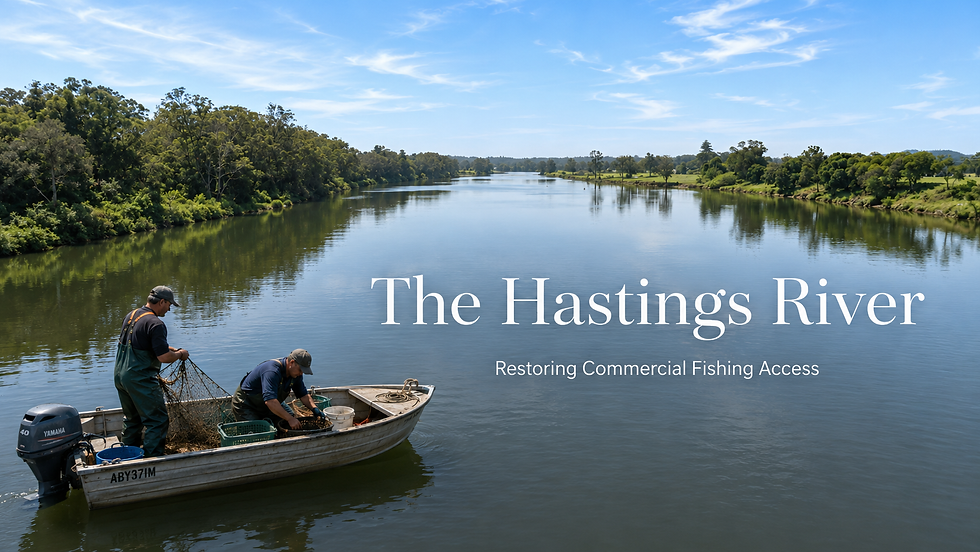
Commercial fishing is a clear example of the contradiction. In ordinary times, fishers are often treated by government as a sector to regulate, constrain, shrink or burden with compliance. But in a real disruption, those same fishers sit inside the domestic food chain the country suddenly needs to remain functional.
That contradiction should not be ignored. A government cannot spend years narrowing access, increasing fixed burdens and hollowing out productive sectors, then assume those sectors will remain intact and ready when crisis makes local supply valuable again.
This is where the Liquid Fuel Emergency Act 1984 becomes more than a fuel law. It becomes a mirror. It shows a state that has prepared a framework for emergency allocation while presiding over policy settings that have too often weakened the producers, transport operators and regional systems that actually sustain the country.
That is not resilience. It is managed fragility.
The language of contingency is already here
This is no longer hypothetical. Governments are already convening fuel-security roundtables, discussing continuity for key sectors, and preparing for pressure across transport, agriculture and regional supply systems. That matters because it shows the language of contingency is no longer sitting quietly in an old Commonwealth Act. It is already appearing in live policy discussions.
Chris Bowen’s suggestion that Australians work from home to save fuel matters for the same reason. It reveals where the burden is being pushed. Instead of asking first why Australia became so exposed, the public is asked to adapt its behaviour around a weakened system. Citizens are encouraged to reorganise daily life around the fragility of the structure rather than the structure being rebuilt to reduce the fragility. That is the logic of manufactured dependence in miniature.
Once governments are talking about continuity, prioritisation and vulnerable sectors, the national conversation has already shifted. It is no longer centred on confidence that the system will simply absorb the pressure. It has moved into the terrain of contingency, allocation and managed scarcity.
The Liquid Fuel Emergency Act 1984 provides the legal architecture for that world. Manufactured dependence helps explain why that world feels closer than it should.
For commercial fishing and other primary industries, the risk is not only shortage itself. It is being recognised too late. Food producers are essential before disruption, not merely after a shortage has already forced government to think in emergency categories. The same is true for freight and the broader supply chain.
If governments only discover the strategic value of productive sectors during a fuel crisis, then the policy architecture has already failed.
A country should not plan for shortage more than it plans for resilience
The Orwell parallel matters only if it leads somewhere serious. The point is not that Australia has become Orwell’s world. The point is that once abundance is neglected and dependence deepens, central control becomes more relevant, more thinkable and more administratively normal.
Scarcity invites management. Manufactured dependence invites control.
A resilient nation should not have to choose between chaos and command. It should maintain enough domestic strength that emergency powers remain what they are supposed to be: a last resort.
That means asking harder questions than whether the rationing framework is ready.
Why are governments better prepared to allocate scarce fuel than rebuild sovereign resilience?
Why are productive sectors expected to carry the burden of national food and freight security while remaining secondary in the architecture of emergency planning?
How much more domestic capacity will be lost before Canberra admits that manufactured dependence is not efficiency, but fragility by design?
The real warning in the Liquid Fuel Emergency Act 1984 is not that Australia has emergency powers. It is that the country has allowed those powers to become more relevant than they should be.


Comments