
Fuel Security Is Food Security: What Will Australia Eat If the Diesel Stops?


Fuel security is food security, and both major parties have helped leave Australia exposed by hollowing out refining capacity while primary producers carry the risk.
For years, Australians were told not to worry about fuel security. We were told global markets would provide. We were told imports were efficient. We were told refinery closures did not really matter.
That line has now collided with reality.
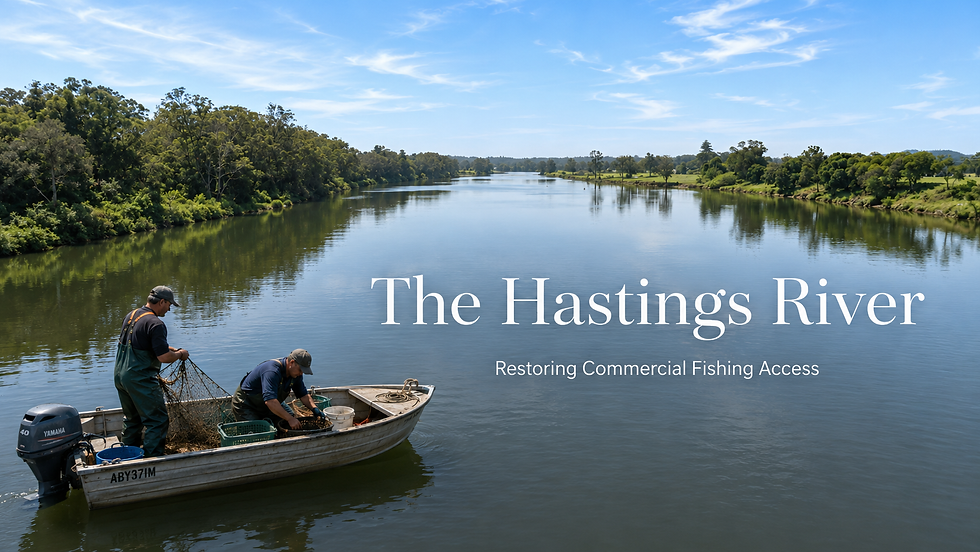
Regional fuel supply has tightened. Service stations have run dry. Marinas in Northern New South Wales have struggled to secure diesel. Fishing trawlers have been stranded. Farmers have been warning they cannot keep operating if fuel supply remains uncertain. Recent ABC reporting has documented stranded trawlers, diesel shortages and supply stress affecting rural operators.
What was once dismissed as a technical policy issue is now plainly visible for what it always was: a national vulnerability. And because diesel sits underneath farming, fishing, freight and cold chains, this is not just a fuel story. It is a food story.
That is why fuel security matters far beyond the bowser. If fishers cannot fuel their vessels, local seafood supply tightens. If farmers cannot run machinery, planting, harvesting and transport are affected. If freight operators are squeezed, food stops moving efficiently from paddock, port and processor to shelf. The federal government’s own fuel security material makes clear that diesel is central to transporting food, equipment and medicines.
You cannot have food security without fuel. You cannot pretend a country is resilient when its food-producing base depends on imported refined fuel and a system that becomes stressed the moment global disruption hits.
This did not happen by accident. It was built over time, and both major parties wear responsibility.
Australia had seven operating refineries in 2010–11. Today, only two fuel refineries remain: Geelong and Lytton. The closures happened under both Labor and Coalition governments.
Clyde closed in 2012 under Labor.
Kurnell and Bulwer Island closed under the Coalition.
Kwinana and Altona were lost under the Coalition as well.
Port Stanvac had already been shut earlier.
Parliamentary Library material confirms the long decline from seven refineries to two.
The point is not to protect one side and blame the other. The point is that both sides accepted the same basic logic: let domestic refining capacity disappear and trust the market to fill the gap.
Even more damning is that the risk was discussed at the time. Parliamentary material shows concerns were raised about the national security implications of losing refining capacity and increasing dependence on imports, even while the dominant official line held that closures would not materially impair Australia’s fuel security.
That judgment now looks reckless.
Canberra was warned, yet the country was still pushed further towards dependence on foreign refining, foreign shipping and long supply chains running through vulnerable regions.
Now the same system that shrugged off those warnings has had to admit that refining matters after all. The Commonwealth now explicitly says its fuel security measures include maintaining sovereign refining capability through the Fuel Security Services Payment. In plain English, the government is now subsidising the last surviving refineries because it finally recognises that domestic refining has strategic value.
And that leads to the harder political point.
If subsidies are warranted anywhere, they are warranted in matters of national security.
Australians are constantly told that governments cannot support every industry, cannot preserve every capability, and cannot step in whenever a market decision causes national dependence. Yet somehow there is always money for fashionable causes, bloated bureaucracy, discretionary spending and politically useful programs.
The Home Insulation Program became one of the clearest examples of catastrophic policy failure, with parliamentary material recording four installer deaths and at least 174 house fires linked to the scheme.
At the same time, the NDIS has been plagued by fraud and exploitation serious enough that the government’s own Fraud Fusion Taskforce said it investigated $1 billion in NDIS payments in its first year.
That does not mean the NDIS itself is illegitimate. It means governments have tolerated enormous leakage, misuse and abuse in one area while acting as though direct support for sovereign fuel resilience is somehow beyond the pale.
That contrast matters. Because for all the lectures about efficient markets and prudent spending, when it came to fuel security, both sides of politics were content to let strategic capacity shrink.
The result is a nation that still sits below the International Energy Agency’s 90-day oil-stock obligation. Official figures say Australia averaged about 50 IEA days in 2024–25, still well short of the 90-day benchmark.
Yes, ministers point to domestic stock levels and say Australia currently has around a month of petrol, diesel and jet fuel under the current framework. That is better than nothing. But it is not the same as deep resilience. It is a thin buffer in a country that imports the overwhelming majority of its liquid fuel and now has only two refineries left.
The present disruption shows how quickly that weakness spills into the real economy. ABC reporting says dozens of fishing trawlers have been stranded by worsening fuel shortages and that suppliers have warned farmers and fishing operations are days from grinding to a halt. Local reporting on the Coffs Coast also said some servos temporarily ran out of diesel and that the fuel wharf at Coffs Harbour International Marina was reserving diesel due to price uncertainty.
This is not some distant thought experiment. This is what fragility looks like in real time.
For primary producers, the implications are obvious. Fishers cannot catch food without diesel. Farmers cannot produce food at scale without diesel. Trucks cannot move food without diesel. Cold chains cannot preserve food without diesel and energy security.
Strip away the jargon and the core truth becomes unavoidable: fuel security is one of the foundations of food security.
So what happens if governments keep treating this as a temporary inconvenience rather than a structural warning?
What happens if another disruption lasts longer?
What happens if the next shock hits at harvest, in peak freight season, or during a broader geopolitical crisis?
What will Australians eat if primary producers are forced to stop operating?
That is the question Canberra should have asked before it let the country become this exposed.
Both major parties have spent years proving they are willing to throw taxpayer money at the wrong things. They have funded failures, tolerated waste, chased political fashion and ignored strategic capability until a crisis made the consequences visible. But when it came to refining, reserves and sovereign fuel resilience, they looked the other way.
The lesson should be simple by now.
National security is not only about defence hardware and border slogans. It is also about diesel in the tank, fuel at the marina, tractors in the paddock, trucks on the road and food on the shelf.
Ignore fuel security long enough, and eventually food security goes with it.


Comments