
A Fisherman’s Journey: From Childhood Dream to Industry Advocate

Hooked from the Start
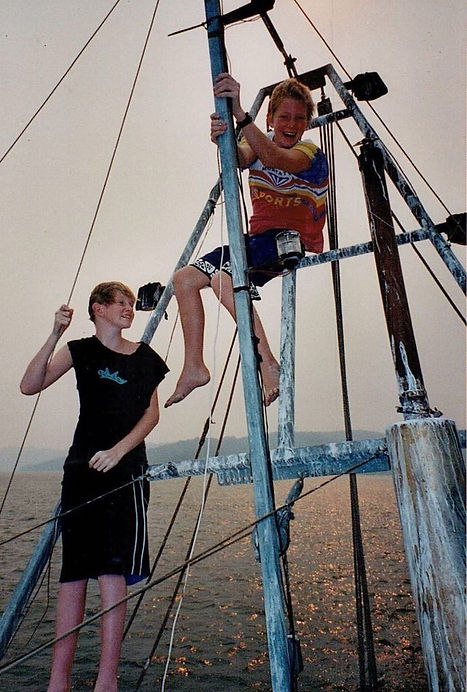
From as young as eight years old, I knew I wanted to be a fisherman. It wasn’t just a passing phase—it was a calling. I remember being about ten, going out on the trawler with Dad and Pop. The very next day, it was my brother’s turn—and I cried the entire time they were gone. That was how much it meant to me.
Unseen Struggles on the Horizon
During the 1990s, changes began to sweep through the fishing industry. As kids, we had no idea. Dad shielded us from the stress he was quietly enduring. For us, fishing meant school holidays helping with the mullet run, sorting males from females, sitting on the beach and soaking up the salt and sun. It felt like the dream.
Reality Bites in the 2000s
By the early 2000s, new restrictions, quotas and buyouts were introduced. Still, Dad never let on. In 2002, I finished Year 10 and made the decision to leave school to fish. But Mum and Dad had seen enough of the industry's uncertainty. They encouraged me to try something else, so I went into labouring—carpentry, plumbing and scaffolding—doing whatever I could to stay afloat.
Detours and Dead Ends
At 18, I got my RSA and RCG and started working in pubs and clubs. Eventually, I landed an interview for a full-time telemarketing job. That’s when Dad pulled me aside and said, “If you're going to do that job, you may as well buy a fishing boat and go fishing.” That moment lit the fire again.
I kept my bar job so the bank would see steady income and spent my days off as a deckhand on the trawler. The training had officially begun.

The First Catch: Lois
In 2007, I found a business to buy—only problem was, no boat. Then, while waiting for mullet to come along on the beach on the beach one day, a fisher told us he was selling his trawler. I had the money, we made the deal, and the rebuild began: engine repairs, cabin upgrades, new paint, fresh hydraulics, and a deck box.
By November 2007, Lois, a 26ft timber trawler, was ready to go. I was finally fishing. I started with day trawling for squid during a severe drought, oblivious to the bigger political fights happening over environmental flows and water rights. I just wanted to get better at my craft.

Lessons from the Sea
Those first few years weren’t smooth. I ran aground, hit reefs, lost gear—but I never gave up. In 2008, the rains came. After several good freshwater flushes and then a flood, I gave prawning a crack. Dad showed me the upriver shots, and I already knew the marks in the bay for night trawling.
Up the river went great. In the bay, I discovered a problem: I got seasick. Total disaster. But with tablets, I managed. Eventually, I weaned off them—and to this day, I’ve never been seasick in the bay again. The ocean’s another story—I’m still the one providing the burley out there.
Fishing the Seasons: A Life Across Multiple Fisheries
Over the years, I’ve worked across a wide range of fisheries, gaining a deep understanding of the seasons, species and gear types. My main focus has been estuary trawling in summer, chasing prawns and squid. Come winter, I’d shift to lobster trapping, a slower-paced fishery that demands strategy and timing. In between, I stayed busy with beach hauling during the mullet runs, meshing in the rivers, and handlining when the conditions suited. Each fishery taught me something new, and together they’ve shaped me into a well-rounded, year-round fisher.
Two boats and two paths become one
By 2011, Dad and I decided to merge our operations into one boat, splitting our focus—one of us go for prawns, the other for squid and we started our partnership Hawkesbury River Seafood. But the regs were tight: only four trawlers over 10m existed, and none were for sale. We found an 11.8m licence and a trawler called Seadrift, but when we saw it, we realised it should’ve been called Driftwood. It wasn’t viable.
Enter Lyndy
Then came Lyndy, an 11.3m timber trawler from Newcastle with a rough past—scuttled, salvaged, and reborn. We towed her home using Dad’s trawler, the Junee B, only to discover Lyndy was missing... everything. No motor, no winch, no steering. Just a hull and a dated cabin.
Fortunately, Seadrift had all the working parts Lyndy needed. By January 2012, we’d sold Lois and Junee B, and Lyndy was ready. We were fishing again.

The Storm That Nearly Took It All
Then in May 2012, a weather event smashed the coast—50-knot winds, massive swell. We moved the boats to a safer bay. The next morning, I got the worst phone call of my life: a trawler was on the rocks. We raced down. As we turned the corner, I saw it: Lyndy, on her side. My heart sank.
The hull was full of water, a huge hole punched in her starboard side. I thought it was all over.

A Community Rallies
Then something incredible happened. The community showed up—fishers, oyster farmers, tradies. We patched her with plywood, Sikaflex, chain blocks and brute force. We drilled into rock to make anchor points. Time was everything.
At the next high tide, she floated—just in time. We towed her to the slipway, oyster punts beside us running pumps non-stop.
Then came the second miracle—a community benefit night raised thousands of dollars to help us rebuild. It’s something my family will never forget.
From Deckhand to Defender
By 2012, I started getting involved in advocacy. A new reform program was coming that would change the industry forever—forcing fishers to buy one another out to stay in. I joined the Australian Marine Alliance as head of NSW, launched a podcast (Commercial Fishing Media) and ran the Save Australian Seafood Consumer Rights Facebook page with Donna Cook.
Fighting for Our Future
In 2015, we brought all the advocacy groups, co-ops and fish markets together to fight the reforms. Not everyone stayed the course, but we pressed on and formed the Wild Caught Fishers Coalition.
Then in 2016, the reform passed—with just 0.4% industry support. We lost 400–500 fishers overnight. The damage was immense.
A Boat Worth Believing In
In 2016, we decided it was time to take the boat from simply operational to something we could be proud of—something that felt like ours through and through. So, we took on one of the biggest projects yet: building a brand-new cabin and front deck for Lyndy.
This wasn’t just maintenance—it was a full transformation. We stripped her down, planned it out, and put in the hours ourselves with the boat builder we knew we could rely on Gary Hyde. Every screw, every plank of timber was placed with the intention of bringing the boat in line with what we’d always dreamed of—a strong, practical, reliable working trawler that could go the distance.
It was a massive undertaking, but what came out the other side was a vessel that finally felt complete—not just seaworthy, but a boat we could look at with pride and say, “This is ours. This is us.”
Rebuilding Unity
In 2020, we made another attempt to unite the industry. It finally worked in 2024, when even the other organisations saw the need to come together. I now sit as a board member and Public Officer for the newly formed NSW Wild Harvest Fisher Inc.
I chose not to recontest the recent election because my focus needs to shift shifting—to bringing consumers and fishers together, uniting those who catch our seafood and those who love to eat it. Watch this space.
Still Standing. Still Fishing.
The industry is still here. My brother is finally fishing, and Dad is “retired”—although if you ask me, he’s as busy as ever, still welding, building nets, and helping anyone in need. Josh and I have now started Ocean Truth Australia, that will soon include a weekly podcast, and we have entered the realm of film making with our first 4 min documentary "Fighting back through innovation"
available here.
We’ve been through storms, reforms, and setbacks—but we’re still fishing. Still fighting. And always ready for what’s next.


The politics behind the management of commercial fishing in NSW is taking away the fresh seafood from the plates of consumers. It is time to wake the consumer up to the fraud that is in the management regime currently in place.