
What the Hastings River Has Taught Us About Restoring Commercial Fishing Access

Updated: Jul 31
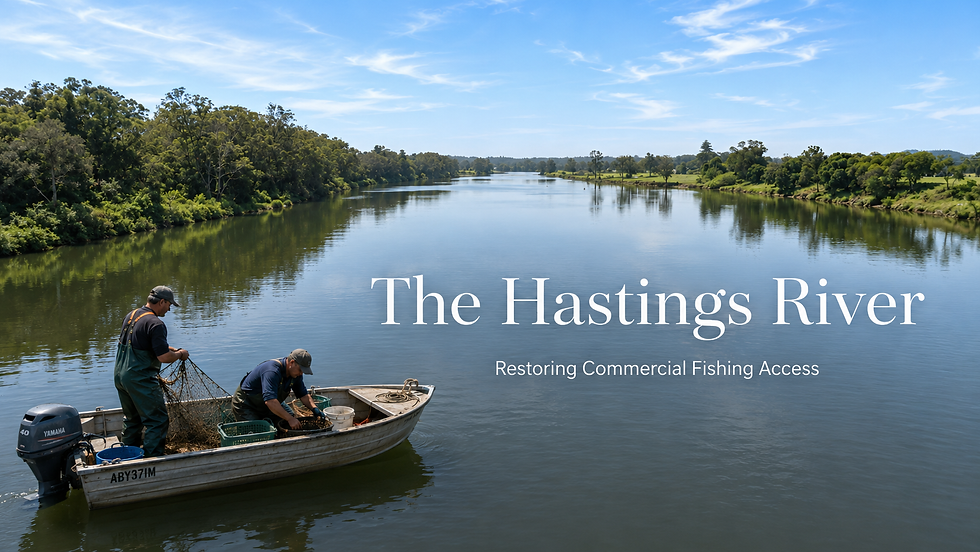
On the NSW Mid North Coast, around 16 or 17 commercial fishers share what remains of a small and environmentally variable fishing area.
According to commercial fisher Jeremy Hooper, their main activities include meshing, eel fishing, crabbing and estuary prawning. Around Laurieton, Queens Lake and Watson Taylors Lake are shallow systems he describes plainly as “duck ponds”. Lake Innes is an intermittently closed and open lake or lagoon, commonly known as an ICOLL, whose connection to the ocean and productive capacity can change with environmental conditions.
These fishers do not operate across an unlimited coastline. They depend on a restricted collection of estuarine waters while responding to rainfall, floods, water quality, seasonal movements and the opening and closing of lake entrances.
In that operating environment, the Hastings River is not simply another waterway.
It could provide a lifeblood for the region’s remaining commercial fishers.
Access to the Hastings could offer another productive option when conditions elsewhere are poor. It could reduce dependence on a small number of grounds, spread fishing activity across a broader area and restore some of the flexibility small fishing businesses need to remain sustainable.
That is why the Hastings has become more than a local access dispute.
It is now a case study in restoring commercial fishing access, and in what governments must learn if Australia is serious about rebuilding its locally caught seafood capacity.
A fisher tried to use the established process
In 2019, Jeremy Hooper attempted to work through the NSW Government’s established resource-sharing pathway.
He developed a localised proposal for limited commercial prawn hauling in the Hastings River. He consulted political representatives, community organisations, commercial fishing bodies and recreational fishing clubs.
The available records show support from the Laurieton and Taree fishermen’s co-operatives, the Professional Fishermen’s Association and several local recreational fishing clubs.
Jeremy was not seeking unrestricted commercial fishing throughout the Hastings River.
The proposal contemplated an experimental fishery with operating restrictions, real-time reporting and ongoing assessment. Continued recreational exclusivity in Lake Cathie was also offered as part of a negotiated outcome.
It was an attempt to find a workable form of coexistence.
Despite that effort, the proposal did not reach an independently assessed trial.
The available records suggest anticipated recreational opposition and concern about setting a precedent became significant practical barriers. However, the Wild Caught Fishers Coalition has not received the complete departmental file or a comprehensive formal explanation of why the proposal did not progress.
That should now be the starting point.
Before government decides what should happen next, it should establish what happened last time.
This is not a demand for unrestricted reopening
The Hastings River, including its tributaries, creeks, bays and inlets, is currently closed to commercial fishing.
WCFC is not asking the NSW Government to remove that closure permanently without assessment. It is asking government to establish and support a fair pathway to design a limited, monitored and reversible trial of commercial prawn hauling.
A trial could be restricted by method, location, season, participating fishers, operating days, number of hauls, reporting requirements and independent monitoring.
It could be suspended if unacceptable impacts were identified. It could expire automatically unless government made a further decision.
The immediate question is not whether commercial prawn hauling should return permanently to every part of the Hastings River.
The question is whether a carefully controlled proposal should be allowed to reach an independent assessment.
That is a far more reasonable test.
Restoring commercial fishing access requires a fair pathway
Every affected interest should have a voice in designing and assessing a Hastings trial.
Recreational fishers should be consulted. Aboriginal fishing interests should be directly engaged. Commercial operators, environmental stakeholders, local businesses and the wider community should all be able to present evidence and propose conditions.
But consultation and consent are not the same thing.
A sector already benefiting from complete commercial exclusion has little structural incentive to support reducing that exclusivity. That does not make its concerns invalid. It means those concerns must be considered by an independent decision-maker alongside ecological, economic, cultural and social evidence.
When the agreement of the incumbent sector is treated as a prerequisite, consultation becomes a practical veto.
The decision should not depend on whether every sector agrees.
It should depend on whether limited commercial prawn hauling can operate sustainably, preserve quality recreational fishing opportunities and provide a broader community benefit.
Fisheries resources are public resources.
Their allocation should be determined through a public-interest process.
The Hastings evidence trap
The Hastings case also exposes a circular problem in fisheries management.
Government may require Hastings-specific evidence before considering a change.
However, Hastings-specific evidence cannot be collected if no trial is permitted.
The absence of local evidence can then become the reason for refusing the activity needed to produce that evidence.
No trial means no local evidence.
No local evidence means no trial.
That is not an effective evidence process. It is an evidence trap.
The solution is not to lower environmental standards or assume prawn hauling would have no impact. The solution is to authorise an activity small enough, controlled enough and monitored closely enough to measure those impacts.
Existing NSW research provides a reasonable basis for considering that approach. A published study of river-based prawn seining in the Richmond, Manning, Wallamba and Shoalhaven rivers found comparatively low levels of bycatch across the fisheries examined.
The operations used relatively small nets and were generally short in duration. Bycaught fish were commonly observed in good condition when released.
The study did not examine the Hastings River and found meaningful differences between estuaries. It therefore cannot prove that Hastings prawn hauling would have no effect.
That limitation strengthens the case for a local trial.
It does not justify refusing to collect local evidence.
When process costs create scale bias
The 2019 Hastings records indicate that the process involved an application fee exceeding $1,000 and an estimated steering committee cost of about $10,000.
Those costs arose before any additional scientific, environmental, economic or consultancy work. They also excluded Jeremy’s time, travel and lost fishing opportunity.
These are historical figures and should not be represented as current departmental charges. They nevertheless reveal a serious structural problem.
Should an individual commercial fisher be required to privately fund the government’s reconsideration of a government-created allocation of a public resource?
There is a clear distinction between normal fishing-business expenses and the cost of public policy review.
Trial participants can reasonably be expected to meet the cost of their vessels, fuel, gear, labour and routine reporting. Baseline assessment, cross-sector consultation, independent administration and public-interest evaluation are different.
Those are functions of government.
When high fixed costs are placed at the entrance to the process, the system becomes biased towards scale. A large organisation or well-funded sector may be able to absorb application charges, consultant reports, committee expenses and years of advocacy.
An individual fisher or small regional group may not.
The proposal can then fail before its ecological or economic merits are examined.
That is not an evidence-based decision.
It is a financial threshold operating through a policy process.
Access is productive infrastructure
The Hastings proposal must also be considered in the context of the fishing grounds that remain.
Around 16 or 17 fishers are sharing a limited collection of estuarine waters. They depend on different methods and species, but their businesses overlap across the same constrained regional footprint.
Fish do not remain evenly distributed. Prawns do not appear according to a government timetable. Floods, droughts, rainfall, temperature and water movement determine where productive fishing can occur.
A small fishing business survives by adapting.
It may move between species, methods and grounds as conditions change. That flexibility allows the fisher to remain viable without becoming a larger, more capital-intensive operation.
When access is removed, the remaining fishers are compressed into fewer areas. Competition for productive space increases. Dependence on particular grounds or methods grows. A poor season in one estuary becomes harder to absorb because fewer alternatives remain.
This is how access loss creates pressure towards scale.
It does not merely reduce the amount of water available. It reduces the operational flexibility that allows small and diversified businesses to survive.
For Jeremy and other regional fishers, the Hastings could provide breathing room. It could offer another option when conditions in Queens Lake, Watson Taylors Lake, Lake Innes or other available waters are poor.
The Hastings would not guarantee profitability.
It could provide the flexibility needed to keep fishing businesses sustainable.
Access should therefore be understood as productive infrastructure. Without it, boats, licences, skills and local knowledge cannot be converted into seafood for the community.
Government created the allocation
The Recreational Fishing Havens were established through a government-administered acquisition program funded through the compulsory Recreational Fishing Fee.
Individual recreational fishers were not personally required to finance separate policy assessments and steering committees for every waterway placed under recreational exclusivity.
Commercial fishers seeking reconsideration now face a different position.
The commercial sector is smaller than it was when the havens were established. It has lost access, participants, earning capacity and organisational strength.
Requiring that diminished sector to privately finance the pathway back creates a self-reinforcing barrier.
Access loss reduces the number and financial capacity of commercial fishers. That reduced capacity makes it harder to fund access proposals. The inability to fund those proposals then helps preserve the original exclusion.
Government does not have to approve every request for renewed access.
It should provide a fair process through which those requests can be assessed.
The government created the allocation.
Government should fund its review.
Temporary approvals can improve permanent decisions
Section 37 of the Fisheries Management Act provides a potential pathway for authorising specified fishing activities in specified waters, subject to conditions and for an approved purpose.
An authorisation can be limited in duration and can include controls relating to method, participants, location, effort, monitoring and reporting. It may also be varied, suspended or cancelled.
The existence of section 37 does not create an automatic entitlement to fish the Hastings River.
The Minister would still need to consider environmental impacts, the objects of the Act and the interests of affected sectors.
Its value is that it provides an alternative to the false choice between permanent prohibition and permanent reopening.
Government can authorise something narrow.
It can monitor the results.
It can then make a longer-term decision using measured outcomes rather than assumptions alone.
That is how uncertainty should be managed.
Commercial access is public access
Resource-sharing debates are often framed around the number of fishers in each sector.
That framing understates who commercial fishing represents.
A recreational fisher generally catches seafood for themselves, their family or their immediate circle.
A commercial fisher supplies the broader public.
That includes families without boats, older Australians, people with limited mobility, restaurants, fish shops, seafood co-operatives, regional visitors and consumers who simply want to purchase locally caught seafood.
Commercial access therefore represents more than the fisher working on the river.
It represents public access to the resource through the marketplace.
For regional fishers, the Hastings could provide productive space and operational flexibility. For the wider public, those fishers are the connection between the resource and the seafood available for purchase.
Food security depends on that connection.
It requires access, working boats, skilled fishers, processing capacity, viable local supply chains and entry pathways for the next generation.
Australia cannot build a future around locally caught seafood while continuing to remove the productive capacity required to catch it.
What the Hastings River has taught us
The Hastings River has taught us that access loss does not simply remove fishing from one waterway.
It concentrates fishers into the limited space that remains.
It reduces flexibility, increases exposure to environmental variability and makes it harder for small businesses to survive without expanding in scale.
The Hastings has also shown how consultation can become a practical veto when government does not clearly distinguish participation from consent.
It has shown how evidence requirements become circular when fishers are prevented from collecting the evidence required to support their case.
It has demonstrated how fixed application and assessment costs can exclude small operators before a proposal reaches an independent test.
Most importantly, the Hastings has shown that restoring commercial fishing access requires a functioning pathway.
A workable process would begin with government accepting a concept for assessment without promising approval. Regional fishers would help identify workable methods and areas. Recreational, Aboriginal, commercial, environmental and community interests would contribute evidence and propose conditions.
Government would fund the baseline public-interest assessment and independent administration.
A limited trial could then measure catch, bycatch, habitat interaction, recreational interaction, compliance, economic return and local seafood benefits.
The final decision would be made against criteria established before the trial commenced, and the reasons would be published.
That process would not guarantee access.
It would guarantee a fair hearing.
A case study with broader repercussions
The significance of the Hastings River extends beyond one estuary and one commercial fisher.
Across Australia, historic closures and resource allocations are often treated as permanent, even when fleet structure, monitoring technology, market demand and community needs have changed.
Fisheries management requires stability.
But stability should not mean that existing allocations are incapable of review.
The Hastings could become a model for restoring commercial fishing access responsibly. Not through unrestricted reopening, but through limited trials, independent evidence, proportionate safeguards and transparent decisions.
That is the Architecture of Renewal in practice.
It asks government to stop treating inherited settings as the only possible settings and begin testing whether better arrangements can be built.
Who should fund the review of a government-created resource allocation?
Does consultation give every sector a voice, or does it give one sector control over whether another proposal can be tested?
How can contemporary evidence be collected if a trial is never permitted?
What happens to local seafood supply when regional fishers are forced to share an increasingly restricted productive area?
For Jeremy Hooper and the remaining commercial fishers of the region, the Hastings River represents more than another fishing ground.
It represents room to adapt, room to remain viable and room to continue supplying locally caught seafood.
Restoring commercial fishing access does not begin with demanding permanent reopening.
It begins by creating a fair pathway through which limited access can be proposed, tested and judged on evidence.
Have You Been Denied a Fair Hearing?
Have you tried to work with the Department to regain fishing access, trial different gear, or obtain permission to travel through closed waters with a net secured onboard solely to reach open fishing grounds?
Were you met with an unclear process, prohibitive costs, repeated delays or a refusal to properly consider your proposal?
You do not have to navigate that process alone.
The Wild Caught Fishers Coalition, supported by the public advocacy work of Ocean Truth Australia, wants to hear your story. We can help document what occurred, identify the structural barriers and support your case for a fair, transparent and evidence-based hearing.
Tell us what happened. Let us help you get a fair go.


Comments