
NSW commercial fishing licensing: price signals over paper

Why rigid licensing kills flexibility in NSW estuaries
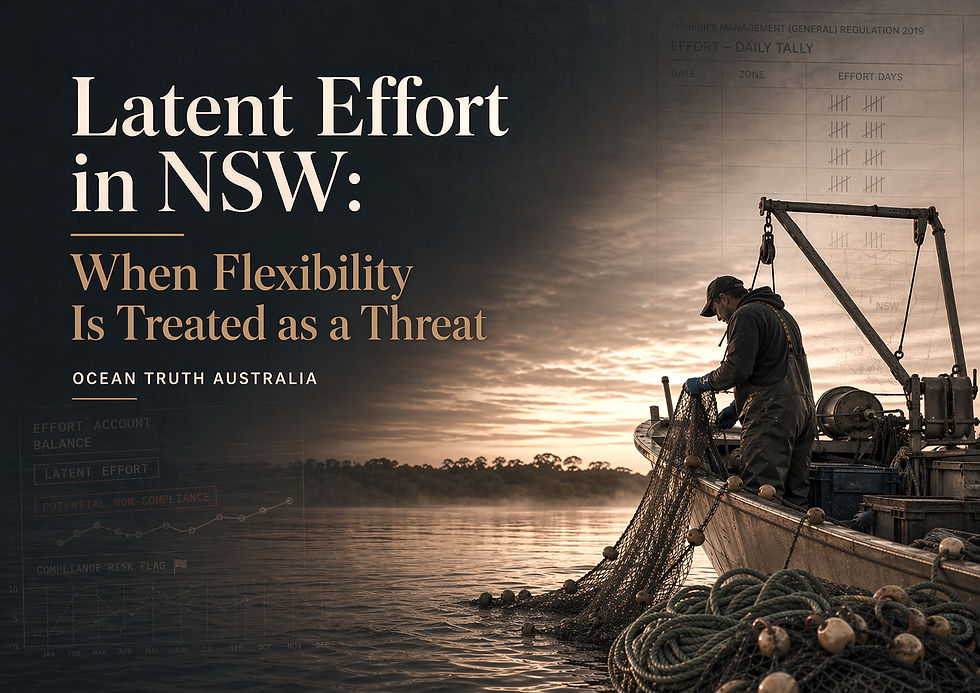
For most of NSW’s history, a NSW commercial fishing licensing was mainly administrative. You followed rules on gear, sizes, seasons and places, and you worked where the fish were. Estuaries are productive, pulse-driven systems where fishers adjust effort as prices and abundance shift. That adaptability is a safety valve for stocks and for household income. When paper walls block lawful switching, both fish and families lose.
Over the past few decades, NSW layered limited entry and then tradeable shares on top of the old rules. What began as sensible standards has become a maze that locks fishers into narrow boxes and blunts the natural “pivot” that price signals create. Hawkesbury example: when squid pulse in the Hawkesbury, prawn fishers up-river will swap gear and go squidding. If a glut forms and buyers pull prices down, they switch back to prawn gear. That is how a healthy estuary portfolio ought to work.
What about the Recreational Sector?
Recreational access remains simple: pay a modest fee and follow bag and size limits, much like the old commercial model.
The draft Mulloway Harvest Strategy moves toward shared harvest limits across commercial and recreational sectors to rebuild a "depleted" stock (as DPI claims; many fishers consider the evidence base weak and unconvincing). DPI materials describe an “annual constant harvest limit” and mechanisms to manage each sector’s share, signalling tighter control than today’s bag-and-size model. It stops short of individual recreational quotas at this stage, but clearly entertains harder caps at the sector level.
A reasonable concern is where this could lead. If hard sector caps are adopted, government may seek “efficient delivery mechanisms” that channel activity through charter operators already under limited-entry business licences. In the extreme, access could effectively consolidate via charter enterprises, with quota-like constraints tied to the operator rather than dispersed across everyday fishers. That outcome is not current policy, yet it is a plausible trajectory given charter is already capped on a one-in, one-out basis.
Fortunately for the recreation sector, by law, every dollar from recreational fishing licence fees is hypothecated into the Recreational Fishing Trusts (saltwater and freshwater). Spending priorities are advised by committees of recreational fishers, and clubs can apply directly for Trust grants. A Recreational Fishing Trusts Advisory Council also oversees expenditure. With low, mass-participation fee points ($35 for one year; $85 for three years), this model builds a large fee-paying base and entrenches a powerful lobby. Taken together, it makes any move to shift recreational access into charter-only, quota-bound frameworks politically unlikely.
The commercial sector lacks an equivalent hypothecated funding base and institutional footing, which helps explain its contraction from nearly 4,500 commercial licences in 1977 to well under 1,000 after 2016 and continuing to fall

How estuary fishers self-regulate through markets
When a species is abundant, catches rise and prices fall. That drop makes other species relatively more attractive, so many fishers switch gear or move grounds. When abundance tightens and prices firm, only a few efficient specialists keep targeting that species, while others peel off. Economists call this a portfolio effect: spreading effort across species reduces risk and stabilises income, and it avoids hammering a single stock just because last week’s price looked good.
In NSW this is lived reality. The Estuary General Fishery is intentionally multi-species and multi-method across most estuaries, and in practice that mix is what lets fishers shift when conditions and markets change.
Where the bureaucracy bites
Two changes have choked that flexibility.
Limited entry and share plans. Estuary General is now a share-managed fishery with minimum and maximum shareholdings and regional endorsements. Access to specific species or methods often requires holding the right share class in the right region. If you do not own those shares, you cannot simply pivot when abundance and prices move.
Targeting rules that block switching. Even where by-product is allowed, rules often state you cannot target certain species unless you hold the matching shares or endorsement. A fisher who sees a short-run pulse cannot lawfully switch to harvest it, even if markets and abundance would naturally pull effort across.
NSW DPI’s own Administration Guide shows how licences, share classes and endorsements interlock. What used to be one licence plus gear rules is now a stack of entry caps, share registers, and method- or region-specific endorsements. The Business Adjustment Program then tied shares to catch or effort, further financialising access.
The core point
Estuaries thrive on adaptability. Fishers already have a vested interest in not depleting stocks because price punishes gluts and the next season punishes greed. A rulebook that blocks lawful switching removes that self-correcting mechanism. Put price signals and strong standards back in the driver’s seat, and let fishers manage a living portfolio rather than a portfolio of paper.


What is disappointing is the knowledge that many managers were well aware of the path being taken, before embarking down the path of the NSW Business adjustment program in 2015 legislation. The restrictions that were inevitable, the reduction of access impact and that multi endorsed estuarine fisheries would suffer the most, world research was known, presented at world seafood conferences held in Mexico and Australia yet governments were guided and progressed down the path of Shares, Quota and more red tape and reduction of commercial fishers in Australia.